Sunday, June 24, 2012

Generalizing Grief for the Greater Good


Have you ever been to a funeral or memorial service? The grieving family and friends have their attention divided between holding back their inner sobs while trying to relate to others who are gathered to share their memories.  The harmony of quivering voices overlying a solemn code of conduct gets punctuated by bouts of laughter from the telling of funny anecdotes.  I suspect the comical stories are tacitly required so that participants have some sanctioned relief from the somber mood. 
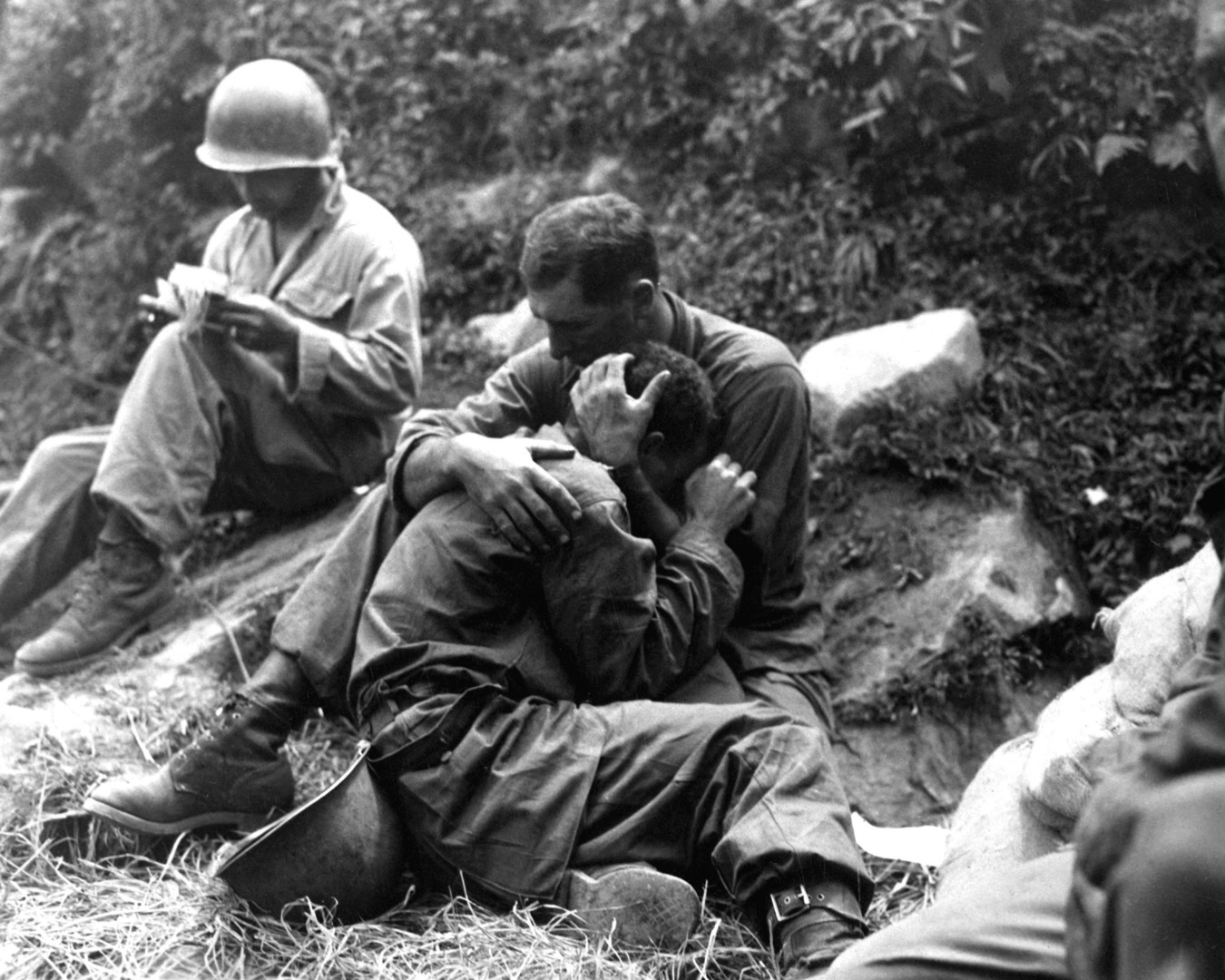
Death is nonnegotiable in its interruption of our lives.  Unthinking routines are disturbed, backroom beliefs are laid bare in the light of self-reflection, and our values have their own “judgment day.”  The sheer fact of death (not many facts have such power) causes us to wonder about the meaning we place in everyday events and things.  Does it really matter if I get a new pair of shoes or a smartphone?  Does my job make me feel meaningfully productive? Are my relationships as deep and healthy as they could be? Would anyone really care if I died?  Have I lived well?  And simply, “How do I cope with Uncertainty?”

All of these questions are important to ask, and their lack of immediate answers often frustrates grievers.  So, in an effort to outwit death, the finality of the fact is stolen.  Tales are told of an unending ego, mightier than the stars who can only burn bright for so many billions of years. Pfft!  In the burying of those questions, the opportunity for transformation is missed.  The transformative potential is projected on the deceased so that they can be resurrected as a disembodied being.  To learn all that death has to teach us is like going to a school of wisdom.  Radical reorientations of values and lifestyles can be accomplished after just one semester.  But Life is always providing us with more semesters, free of charge!

I want to come back to where I began in imagining the grief and potency that death of a close friend or family member has on those who are experiencing it first-hand.  The sorrow feels so personal, despite seeing the pain in everyone else’s eyes.  Intellectually, you know otherwise, but emotionally, it feels as if a madman called Life came into your home and shot up the place.  Sure, others were wounded.  But, you!  You took a bullet straight into the heart.  There is no surgeon skilled enough to extricate that bullet.  Will your heart dare to beat again?  Other people will move on, but will you?  You share your sadness and expose your fragility because what else can you do?  If you don’t, people wonder if “you’re ok” (meaning, “do you need 24/7 psychiatric care?”).  So, you show your grief to let others know that you are dealing with your loss, even if you doubt the usefulness of such a display.  Numbness may even begin to set it.  There’s a complete disconnection from your life and all its unsettled activity that nips at your flesh.  No amount of tears can drown your grief.

Stop there now.  Wallow in those imagined feelings for some moments.


I want you to generalize that state of being.  Explode your feelings outward and cover all of humanity.  People all over the world are experiencing these feelings of isolation and sorrow right now.  Their pain is just as real as yours.  Their loved ones were just as meaningful to them as yours are to you.  Their cries are full of just as much anguish.

We are educated not to generalize because it leads to distortions in our understandings about the world.  All white people are imperialists.  All Americans support war.  All Thais like spicy food.  All educated people are smart. All expensive restaurants have great food. Despite how popular these descriptions are among a group, we learn to be more effortful in not generalizing characteristics and/or assumptions to people who ostensibly belong to that group.  The next time you lay down your credit card for the bill at the three-dollar sign restaurant, you may be wishing you had just gone to the nearest taqueria instead.  Generalizing, just like anthropomorphizing, can lead to all kinds of false impressions.  The grape vine whose “limbs” I severed a couple of weeks back probably did not feel the pain that I imagined it did.

But, people are all quite similar, no matter how much we focus on what separates us as individuals and groups of individuals.  “Those Africans dying of AIDS” are people who are experiencing an endless chain of tragic losses.  Their grief is no less debilitating.  The Iraqi families who have had their lives blown apart by shrapnel suffer daily not just from their losses, but also from the knowledge that those deaths were preventable.  Soldiers’ families are no less caught in this cycle of misery.

Indeed, you know all of this intellectually, but do you understand it emotionally? Politicians and celebrities who suddenly become outspoken about a social/medical issue when a catastrophe strikes their families speak to this division in understanding.  They were not intellectually ignorant about pesticide-caused birth defects, but they were emotionally ignorant.  They did not care that the laborers picking their strawberries were not properly protected from exposure.  The world has been made aware of the dangers that coal miners face, but we haven’t changed our energy sourcing patterns.  We know about poverty and we know that much of the world lacks access to healthy living standards, but the problem continues to worsen.  This is not because we do not know about these issues; it’s because we don’t care enough to find out why.

If a fundamental shift in your personal life were needed so that your loved one didn’t die, would you make that change?  How would you react if the only way to keep your loved one alive was to get me to reduce my constant use of plastic disposable water bottles?  Would you urge me to do so or would that be “too much work” and not worth it?  In other words, your loved one dying was a fair price to pay for my continued convenience of using those bottles. 

It seems barbaric to put it this way, but that’s pretty much how it works, just on a larger scale.  There are proposals for a better functioning social system in which people are properly fed, housed, and educated.  Crime, war, and poverty are not intractable problems of humanity.  They survive because of your terrifying beliefs about “human nature” (with you and those you know as the exceptions to this monstrous nature, of course!).  Examine the science about human social behavior.  Notice how adaptable humans are, and notice what factors contribute most to our well being. By ignoring the problem and remaining steadfastly ignorant, you are increasing the chances that you or someone you love will be the next victim of a stupidly designed social system.  And when your grief overwhelms you because “something could have been done to avoid the tragedy” just remember that they, like you perhaps, didn’t have time or interest to solve such problems.  Your despair was not theirs, so it was not their concern.  As Helen Keller said, “It is hard to interest those who have everything in those who have nothing.” Or more bluntly, it is hard to make other people's problems matter to you.

We cannot wait until we have all experienced every preventable human-created disaster, so that is why we must generalize our emotional experiences.  Being oppressed, losing a loved one, witnessing an injustice, feeling cheated, and being hurt are experiences we have all had.  The specific circumstances were different, but the emotional experiences can be generalized.   As we get better at that, the choice between earning interest vs. making sure no one goes without food will be a no-brainer.  We will naturally act towards the greater good, not because of state compulsion, but because our hearts demand it.

Wednesday, May 9, 2012

Our Era's Racism

Last week I heard this piece on public radio titled, Are candidates' spouses off-limits?, and I just felt so disgusted.  Skip ahead to the 40% mark, and you'll hear what I'm referring to.


The conversation turned to the expensive shirt that Ann Romney wore, and how people felt about it.  Some said she was out of touch with the public, while others, including the host, Larry Mantle, suggested that if she wore less expensive clothing it would be "pandering" because "that's not who they are."  He mentioned that "they're super rich" and "don't hang out with people who don't have much money."  He continued, "as to whether they are sensitive to people like that or not, I don't know them well enough..."

This is the kind of talk that is prevalent in our society, and the meanings behind it are so offensive to me, I thought I'd take a moment to point them out.  I'm going to swap some words to see how it feels:

It would be pandering for white people to hang out with black people.  It's just who they are.  And these white people may or may not be sensitive to the inequities that black people have suffered for generations, and it doesn't really matter anyway.

Classism today, like racism in our past, passes without recognition.  Notice that the host said, "sensitive to people like that" and "who they are."  The implied meaning is that rich and poor are internal characteristics, part of their being.  Skin color is part of our genetic code while being rich is not, and yet we figured out that racism is unacceptable.  The fact that we treat rich and poor as though they belong to different species is obscene.  It is what allows people to believe that the rich and poor deserve different treatment.  Rich people deserve to have whatever they can buy, poor people barely deserve food, unless the rich are "charitable" enough to help them out with only "pennies per day."  Starving people just ruin the view, after all!  But, they are poor, so what can be done (throwing hands up in smug resignation)?

Start decoding the language and see how references to rich and poor fly by unnoticed.  Our culture needs to make a dramatic shift in understanding that does not segregate people based on their money access.  It is no more palatable than racism, and there should be a sense of shame around classist language.

Monday, April 30, 2012

Crush Bottle After Use

CRUSH BOTTLE AFTER USE   is a notice appearing on most water bottles in India.  Why is that important? At first, I thought it had something to do with recycling.  There was recycling going on, but not the type I had imagined.  I was corrected and learned that this notice was a measure to prevent against fraud.  What kind of fraud would that be?  It turns out that uncrushed bottles were being fished out of trash piles and refilled with tap water to be resold as bottled water.  Ingenious!  The sellers, in their ostensible zeal to offer great customer service, would quickly "open" the bottle for you, while handing it over.

What would compel someone to deceive a buyer in this way?  These bottles of water are not that profitable, and the potential for harm is high.  In a nation crowded with poverty and resourcefulness, this practice was widespread enough that it warranted the notice.  Can we really blame someone for trying to eke out an existence on the few rupees they could get by selling "recycled" water bottles?  Aren't they just looking out for themselves in a world that offers no alternative?  A CEO doesn't want you to be homeless; he is just making sure the company's stock is valuable.  The small businesswoman doesn't want to lay you off, but she can't stay competitive with operating costs inflated by your salary.  It is what is required.  


If you don't like this "ruling value syntax" (John McMurtry), then see how you can change the value orientation.  Until you realize the condition, a bewildering array of symptoms will continue to proliferate faster than you can imagine them.

Thursday, March 1, 2012

Stop Waiting For Superman

I just finished watching Waiting for Superman, an emotionally evocative documentary about students in American schools.  A large part of the film focuses on the dilemma of educational reform in an environment of ironclad tenures that are vigilantly defended by teachers’ unions.  The documentary briefly mentions that these teachers unions arose decades ago because of mistreatment of educators (as is the history of most unions).  Now, those unions have become very politically powerful and they work to protect teachers, even if that protection comes at the cost of student success.

But wait! What is meant by “protect teachers?” Are teachers who just sit in class waiting for the day to go by because they can’t stand their jobs actually “protected?” I had one of those teachers who said we didn’t even need to talk to him because our assignments were written on the chalkboard.  He would spend the class time reading his newspaper with the soles of his shoes staring at us.  Maybe he had his eyes down there because he was definitely sitting on his head. 

Are hating kids and feeling miserable about the classrooms and hallways teachers inhabit 5 days a week something to be preserved and protected?  No, the real meaning is that their salaries are protected.  Or more to the point, their access to a means of living protected.  No wonder.  In an economy where every person must sell themselves on the labor market as their ONLY means of earning a living (unfortunately, there’s no alternative economy in which people are provided free access to life’s resources in our wonderful FREE market), it only makes sense for them to defend their tenures/salaries/means of living.  So, teachers, who have a decent degree of social respect for their professions, and sufficient incomes to fight for their means of life, are able to “protect” their livelihoods.  Students, and particularly students of non-wealthy parents, are not able to access a meaningful education.  They suffer the consequences of this broken system throughout their lives.

The film tries to end on a high-note with a review of the KIPP school program, which has had undeniable success in producing students with better test scores.  I’m not sure how the schools function in terms of student well being, but let me leave that aside for the moment.  These KIPP schools are scarce, and because they receive public funding, they must use a lottery system to determine who gets admitted.  The film follows five kids and it shows them anxiously waiting to hear if their number gets called.  You can also see the other parents and children in the background nail-bitingly attending each utterance from the announcers hoping the next name or number called is theirs.  As the number of names called grows and the available seats reduce, the sense of desperation on their young faces makes you want to rush in and rescue them all.  You hold on to hope to the last number, because that’s how all movies resolve the climax—at the last minute, and in the favor of the protagonist.  Not in this case.  It’s real life and most of the featured kids don’t get called.  The shattering of hope for the kids makes it difficult to hold back the tears.  Then, the realization on the parents’ faces that not only have their children missed an important opportunity to improve their lives been lost, but that they, the parents, have let their kids down.  Mommy can’t make it better.  She can’t throw money at the problem and make it disappear.  Their daily fight with the cruel market world, against which they try to insulate their kids, is a losing battle.  The system is king, and they are the pawns.  Somehow, they must summon all remaining strength not to let their sense of defeat, worry, and despair spill over onto their kids.  They have to console their children because it is their pain that takes priority at that time.  Despite every Herculean effort to shield their kids from the continuous battle to provide a better life, their kids know.  The kids know that their parents can’t protect them from the harsh world.  They know that the impact of this lottery is not just about where to go to school, but a lottery about how their lives will turn out, and it’s looking less and less favorable. 

These are the unsparing sacrifices we make to perpetuate our outdated, insufficient, and barely-above-savage social system.  All those people who work so hard to critique a resource-based economic model to find any unpleasantry, any objection, any difficult challenge that would be faced in an RBE amaze me in that they seem to overlook all the heartache of our current system.  It’s like they measure an RBE against a fictional utopian standard, in which everyone gets everything they want and problems are extinct.  They use that to argue against an RBE, without noticing that their measurement should be against our current system.  Proponents of an RBE do not expect utopia, just a life and planet a lot better off than what we have now.   With all the road kill caused by our current system, it feels like there must be a thousand better options, which is all we need—better!  And it sure is time for better, unless we want to continue to watch lives hinge on the outcome of lotteries.  

Wednesday, January 25, 2012

Regarding The Educational Imperative

It is commonly understood in the Zeitgeist community that education is the means by which we can move into a transitional economy, which will evolve into a transformed society that respects and advances each person’s well being. By educating people, we intend to promote the value shift that becomes necessary to survive on this planet—the shift we have all experienced through recognition of certain vital facts that dismiss outdated understandings of human nature and faith in the monetary-market regulating paradigm.  After being disabused of these cultural myths, and comprehending a unifying perspective that twines the seemingly disparate strings of planetary suffering into the rope and noose of a core social danger, we are compelled to share with each other.  Such is the sensible response.  Like the sentinel meerkat warning its playful clan that danger threatens them all, we cry out in hopes that we will be heard and our clan will act.

Our clan is stubborn, though.  Many will not listen, and some will react violently.  The pugnacious status-quo defenders already notice that something is “wrong with the world,” but their ideological helmets constrain the expansion of their perspectives.  They’ve already committed themselves to this battle, so deeply entrenched in a worldview where war is the only means to resolve the problems.  To peer above the trench is not an opportunity to see if the war is worth fighting; it’s just a risky move that will end with a bullet to the head.  To be exposed to the body of evidence gathered under the Zeitgeist library beckons the inner skeptic, anthropologist, and psychologist to lay bare a history of woe and a “self” identified with that woe.  Make no mistake! Even those who have been most advantaged by this system have at least some awareness that their profit has come at the cost of their conscience.  Wounded are we.

Those that do not listen because they “have better things to do” are generally too busy “keeping their heads above water,” not realizing the forces that conspire to drown them.  Or they have an artificial divide between their lives and the rest of the world.  This lack of awareness may be natural in the sense that we are not born with a mature understanding of the complex relationships that exist in, around, and between us.  It does not mean that no effort should be made to displace that ignorance.  Humans are not born literate, but we make considerable effort in educating people to become so because it provides them with unceasing access to useful and entertaining information.  Similarly, every effort should be made to foster people’s understanding of the ecological framework in which they live their lives, and the ways in which nature circumscribes our behavior. When we have a better grasp of what limits nature sets, we actually gain more freedom from what our minds conceive as “the limit.” Nature is a much bigger thinker than we are, which is why scientists discover unimagined life forms, cosmological marvels, and invisible realities.  Charles Darwin recognized this when he stated, “We are not here concerned with hopes or fears, only with truth as far as our reason permits us to discover it” (Descent of Man).

The goal of the Zeitgeist Movement to educate is necessary and logical.  We cannot create a new, sustainable, and emergent society without a comprehensive education to allow the maturation of ecological perspective (I use the term ecological in the broadest sense possible, inclusive of the interconnections among earth, society, and psyche).  The predominant conception of “education” needs to be examined.  When people discuss education, there is a somewhat narrow view that it means sharing written or verbal intellectual information that will stir one to question their own ideas and revise when reasonable.  We intuitively know that this isn’t always effective, but we persist anyway.  The Zeitgeist Media Festival and Media Project are addendums to the educational campaign that seek to connect emotionally with people.  

Ultimately, the movement is concerned with accelerating a value shift, and my purpose in writing this article is to encourage members to embrace an omni-directional approach to “education.”  Some people will be moved by the plentiful intellectual output, and some by the artistic output, but for this movement to reach critical mass, it will need to reach a very diverse population of different motivations.  A common conclusion is that either people wise up or they will have to deal with painful bio-psycho-social disasters.  Various forms of protest, so-called “sustainable community” projects, and cooperative farming are seen as outside the scope of the Zeitgeist Movement.  Alternative currencies like time banking or community-based “dollars” are properly criticized as corruptible and inadequate for accomplishing the lasting change we need. 
I understand and appreciate these criticisms and they serve to remind us—repeatedly—that we should not lose sight of the bigger picture.  However, such community-based initiatives can be seen as a learning tool to show members of our communities that we can and should work together.  Strengthening social bonds and social responsibility will give us pause before rewarding behavior that is loyal to the prevailing “golden” rule: profit over people.  Rampant misguided individualism, ideologically driven by “freedom from society” and “my property” are colossal barriers to the value shift that is necessary for a new society to take root.  Scientific evidence will compel a definite segment of the population to overhaul its value system, but as we can see with religions, reasoning alone will not suffice.  Direct experience in real situations that challenge people’s beliefs regarding human nature and social systems requires them to reach beyond their conditioned reflexes and ideas.  Protests, community projects, and alternative currencies may provide those challenges at different levels of meaning for a greater variety of people.  There are, no doubt, many other forms of situational challenges, but it is important to ask if a particular situation can serve as a transformative educational tool.  So, let’s not get stuck in confined paths of “education” and be open to a broad, multi-layered approach. Besides that, people will want to be activists in various ways, and that is the promise of a resource-based economy: people contributing in ways that fulfill them with an understanding that social interest and personal interest need not be in conflict with one another.  When we help each other, we help ourselves.

Tuesday, November 29, 2011

Bad Decisions


A few years ago, a nameless couple signed a contract with pages of purgatorial fine print that committed them to decades of debt so they could own a home.  The economy crashed, their house value plummeted, one half of the couple was laid off, and making ends meet became impossible.  Those who were not so unfortunate blame these victims and sum it up to “they signed the contract, so they made a bad decision.” 

Let’s roll back the clock a bit and look at the perspective of pre-crash days:
Just a couple of years ago, those of us attempting to warn friends against taking out questionable mortgages were ridiculed as conspiracy theorists.  Didn’t we understand that real estate always goes up?  Or that home ownership was the only way to guarantee one’s retirement?  That the longer you wait to buy a house, the further out of reach that house was going to get? The question of whether to become a home owner gave way to the much more presumptive “How are we going to get you in?” While government promised to encourage home ownership as a way of improving participation by poor people in the economy, banks came up with increasingly clever mortgage products that postponed the real cost of buying a house well into the future…

“What if interest rates are higher in five years?” I asked.“The increase in the home’s value will offset it,” the mortgage broker responded.“What if the house—for some reason—doesn’t go up in value? I asked.“Houses always go up in value,” she responded.“But what if the mortgage resets to a rate I can’t pay?”“Everybody has these mortgages, now.  Banks can’t set the rate so high that everyone defaults.  They won’t make anything that way.”...
Because these borrowers were generally less educated and less experienced with complex banking products, they were also less likely to fully grasp the implications of adjustable rates—often buried deep in mortgage documents only presented at closing, when there’s no time to read through them.  Other high-risk mortgage candidates included homeowners who could be induced to “move up” to bigger properties, and “flippers”—who bought houses with almost no money down hoping to resell them at a profit before the first payments came due. 
---  Life Inc., Douglas Rushkoff
People have limited powers to predict the future, even the experts among us.  Potential homeowners were thinking that houses were a solid investment, the economy was stable, and that they were getting fair and accurate information from their mortgage brokers and realtors.  Is it stupid to trust someone to give you true information?  Yes, in this economic paradigm!  Everyone is forced to make a buck off of your ignorance or lack of skill.  The more ignorant and the less skillful, even more profit can be made.  But, we can’t really function in a society where we have a paranoid distrust of all workers we transact with.  Imagine that at every single transaction you run through the scenarios of suspicion:  Do these noodles I’m about to eat have a tummy-upsetting ingredient that will drive me over to the adjacent pharmacy that is well stocked with gastro-drugs?  Is the noodle owner getting kickbacks from the pharmacy owner and from the gastro-drug manufacturer?  Will my iPhone combust so I have to buy a new one and pay for the burn on my hand? (http://www.smh.com.au/digital-life/mobiles/red-hot-smoking-iphone-selfcombusts-on-airliner-20111129-1o3zn.html) Does this shirt have non-toxic fibers so I won’t get a rash?  When my dentist tells me I have five cavities that need fillings, is she just trying to make a sale?  (This actually happened to me and I was thankful I had a convenient opportunity to get a free second opinion that indicated my teeth had no cavities, which is what I expected since I’ve had pretty good dental hygiene.)

It’s so easy to make a bad decision, even when you have good information like picking the tastiest sandwich on the menu.  It’s a lot easier to make a bad decision when factors around you conspire to get you to make that bad decision.  There’s a lot of money to be made in bad decisions. 

There is the other issue of how a bad decision is arrived at.  When I lived in Thailand, I was aghast upon hearing impoverished people spend two to three months of their total salary (via debt) to buy a new mobile phone.  Why would they make such an irrational purchase?  I used to sum it up with, “Idiots!”  Calling them idiots helped relieve my discomfort over figuring out why such a bad decision was made.

Someone declaring that a “bad decision was made” is a sign of a lazy thinker.  It’s a bit like a child shoving the mess under their bed and declaring victory over the Untidy Monster.  No more thinking required.  No more following the chain of causality about the reasoning behind those bad decisions.  And the sad part is not so much the laziness, but the outcome: a deep lack of compassion.  Those bad decision makers should suffer for their sins bad decisions.  The Westboro Baptist Church says that dead soldiers are the natural result of bad social decisions like giving gays closer-to-equal access to citizens’ rights.  Kids get addicted to drugs or involved in mischief because they are “black sheep.”  Problem solved, case closed.  The irony is that labeling an action a bad decision is itself the bad decision because it does nothing to resolve the problem, and in fact, it enables the harmful behavior to continue.  It is a reaction to one’s frustration with oneself from a lack of skill and/or intelligence to truly resolve the underlying problem(s).  

SIDE NOTE: There should be a research study in which Libertarians people who liberally attribute someone's suffering to bad decisions should get offered a license to a great new software program that has in its terms agreement a statement about the right of the patent holder to procure all hardware the products of said software are housed on, including those to whom those products are distributed to (I plagiarized this idea from Monsanto).  The terms should be quite lengthy, coded in legalese, and the software should be something that is a "must have."  I would be interested to see how many people "agree" to those terms.

The roots are deep in decisions we make, and it is difficult to tease out all of the factors.  In looking more deeply at why some Thai people overextended themselves to buy a mobile phone, a few possibilities surface.  Thais have strongly interconnected social networks that advantage them (increase their access to goods/services that promote their survival and well being).  Such strong social networks come with costs that relate to maintaining their membership in a peer group.  If they fall too far behind, they may find themselves without access to that peer group and its resources.  If having a mobile phone is part of that cost, then it may be entirely rational to make that purchase.  Or what about the fact that low-income workers rarely have the opportunity to afford the things the free market is supposed to “provide:” creature comforts?  These workers live austerely day in and out (while seeing extravagance in every billboard, poster, and on TV).  They earn just enough to survive.  If having a small piece of the technological pie makes them feel a little less like life is so dreary, then the purchase is a rational decision.  This is the common advice of dieting so that the diet is sustainable.  Have your cake and eat it, just not every day!  Those who ruthlessly deprive themselves finally relent to their cravings and they abandon their diet.

Of late, there is a lot of new research into epigenetics explaining how nurture affects nature.  Nature (DNA) and nurture act together in a constant dynamic interplay that lead to physiological, physical, cognitive, and emotional output.  One day, you are full of energy and very “productive.”  The next, you can’t seem to focus and chide yourself for not being “productive.”  There doesn’t seem to be a reliable pattern to these swings in energy and mental focus.  Even if you think you have learned how your body systems work, there could be an unpredicted environmental upset that challenges this “reliability.”
In this study, the environment at young ages affected gene expression much later in life. http://www.popsci.com/science/article/2011-10/living-conditions-child-may-imprint-themselves-your-dna-life  Does the child born to a stressed-out parent who then has their “delayed gratification” genes turned off and battles this problem throughout life deserve to be convicted as a bad decision maker?  This is oversimplified extrapolation, but the basic issue remains the same.  Most humans born today are just “bad decisions” made by impoverished and/or uneducated people.  Those kids are punished for simply being the product of that bad decision and now they must pay the price, which is a debt that lasts a lifetime.

Thursday, November 3, 2011

Our Hollow-hearted Neighborhood


A 65 year old man lives near me.  Physically fit and socially active, he is able to live independently.  He has lived in his home for 26 years and has earned his living through a specialized trade.  Business has been steady for him for most of his time as a craftsman, until a few years back.  Since that time, he has struggled to make ends meet.  He has been, as far as I can tell, mostly generous with his neighbors and his church community.  What he lacks in intellectual volume, he makes up for in heart dimensions.  (I have only known him for a couple of years, so I cannot determine if his intellectual capacity has been diminished over time by aging, lack of mental exercise, or exposure to toxic chemicals in his trade.)  As he struggled to pay his bills over the last several years, he began to fall behind in payments.  His church community did not help him.  God didn’t give him a stipend either (jest).  Desperation coupled with a lack of awareness about modern tactics to exploit people like him, he fell for one of those infamous “you won the lottery, but must pay us to claim your prize” scams.  I tried to warn him after he had already invested money from himself and his family who found the scam credible.  Ultimately, it was revealed that it was indeed a scam, and he was not able to recover the money.  His relationship with his family was severed by them (in their anger over their losses), and so he was left to his own devices.

His house went into auction, he was scraping up any jobs he could get, and finally his truck broke.  The damage was around $6000 to repair.  He had no money left, had a terrible credit score, and was not able to get himself out from under his mounting debt.  An eviction notice appeared one day, and he tried to work with a lawyer to stay in his home.  A few weeks later, the sheriff came to tell him he needed to vacate the house.  The sheriff also explained that many scam artists are targeting victims to pay them for legal work to save their homes, when in fact they are just exploiting the homeowners’ ignorance and distress. 

I wish I could help him, but I have a house full of roommates and there is no space to accommodate another person.  I am also looking for work/income, so helping him financially is not an option either.  Instead, I just watch the savagery of our economic system twist itself ever tighter around his neck with his gasps for help going unanswered.  I realize my activism efforts won’t help him or anyone in the immediate future, but I hope that they will help future generations. 

Proponents of our current system would like to argue that it is his fault for not being smart enough, for not saving enough, for not being skilled enough to pick up other work, and for being too generous when he should not have been.  Our economic regime is a game that everyone must play because there is “no alternative” to the “free” market.  Just like in sports, some people play well and excel, while others are less adept (at that particular game) so they either get shunted to the side or develop their skills somewhere else.  Non-athletes may not be admitted to the top tier of sports teams, but they do not have their means of life cut off.  In our economic regime, your access to life resources depends on how well you play the game.  Losing is synonymous with death.  It is the ultimate penalty. 

When you can use the lens of an anthropologist, the game is revealed for what it is: brutal, competitive, uncompassionate, and entirely unmoored from the “life ground”.  The savagery of cultures from the past seems not so ancient when properly juxtaposed to our current economic system. 

What if I proposed that all access to means of life was determined by one’s ability to throw a discus?  The further you could throw it, the more resources you got.  Those who had less genetic power to grow their muscles would be starved, which would then make them even less likely to grow muscles.  Their spiral of downgraded access would leave a trail of misery until their deaths.  Such an economic system seems so ridiculous to us now, but after generations, it would seem inherent to our culture.  Justifications would arise for why the system must be preserved and how it is “fair.” Revolution would be too radical and upsetting; besides, everyone had a fair chance to develop their discus throwing skills. The anthropologist would see the system for what it was: an arbitrary system of rules that leads to great abundance for some, but leaves many destitute.  The anthropologist would have no existing prejudice about the “deserved” nature of those with muscles and discus throwing abilities.  It would appear to be exceedingly contrived and divorced from its purpose to provide people with access to life-advancing resources.

So, while humans struggle to find their bearings in understanding our global dehumanizing economic paradigm of money-for-more-money, my neighbor gets tossed out of his home into the hollow-hearted social body.  I do not know what will happen to him and try to not speculate much.  And while my neighbor’s situation forms part of my local perspective, there is the reminder that his proliferation of despair is more benign than those who struggle to get enough calories and clean water every day. 

There should be enough examples to provide the coup de grace to this barbaric social system, which dictates the prescriptions and proscriptions for resource allocation.  Without the correct diagnosis, uneducated prescriptions will merely modify the system’s disease pattern instead of resolving it.  Awaken your inner anthropologist as the first step.